Sign in. It’s quick, free and it’s up to you.
An account is an optional way to support the work we do. Find out more.
Sign in. It’s quick, free and it’s up to you.
An account is an optional way to support the work we do. Find out more.
LAST UPDATE | 26 Oct 2025
A SEA OF phones were held aloft in front of Catherine Connolly as she stood in Dublin Castle, speaking for the first time as the next president of Ireland.
Everyone wanted to get their photo – but more than that, everyone wanted to get their clip for their Instagram story.
It was a fitting image for the crowning moment in an election that has widely played out on social media.
Many of the viral clips from this election had view counts that rivalled the numbers RTÉ and Virgin Media pulled in for their debates.
The two candidates we were left with in the end – Connolly and Fine Gael’s Heather Humphreys – took very different approaches to their online campaigning.
Humphreys posted content that we’re familiar with: scripted speeches to camera, clips of her interacting with people on the campaign trail, and touching clips that gave an insight into her life with her family and her grandkids.
However, the content from her campaign that really went viral were the attacks on Catherine Connolly, including a documentary-style video which attacked Connolly’s prior work for banks as a barrister.
Voiced by an unidentified person and almost three minutes in length, it was the most widely-viewed single piece of social media content posted by Humphrey’s camp.
Though it was posted from the Fine Gael account on X and Facebook, it saw Humphreys face awkward questions from the media about smears and negative campaigning, and undoubtedly, it impacted the public’s perception of her.
Catherine Connolly's hypocrisy. pic.twitter.com/46ZE30e6eY
— Fine Gael (@FineGael) October 19, 2025
Before Catherine Connolly began her campaign to be president of Ireland, her Instagram page was made up almost entirely of clips of her contributions to the Dáil chamber.
Some of them were shared widely: on 30 May this year, a video of her calling on the Tánaiste to demand a UN-led call for a complete ceasefire in Gaza, in which she calls the EU “morally corrupt and inept”, was liked over 33,000 times.
The personal posts were limited to “Happy Easter” and “Happy Christmas”, with photos not of herself, but of candles and lit fireplaces. Her audience didn’t get much of a sense of her as a person.
Early on, her campaign changed this approach and made social media a social pillar of their strategy, recognising the importance of having Connolly show up in people’s feeds.
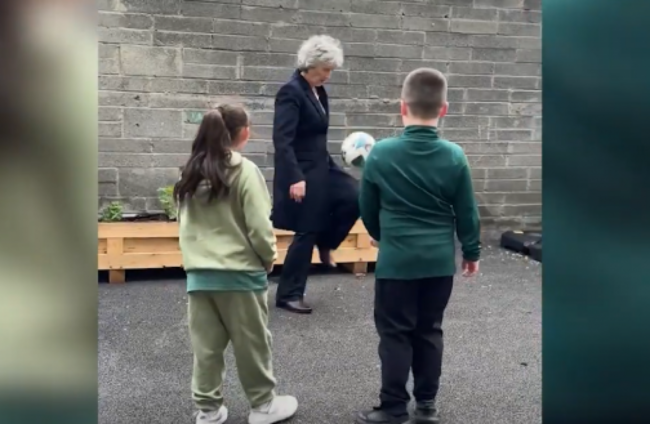
When The Journal spoke to voters over the course of the race, many who were less politically engaged had only seen what made it onto their social media feeds, and time and time again what they had seen was clips of Catherine Connolly: Connolly playing football, Connolly at a sold out gig in Vicar Street with the likes of Christy Moore, Connolly smiling and talking to people.
So how did the Connolly campaign get a candidate who does not like giving the public an insight into her personal life to connect with voters?
Campaign manager Béibhinn O’Connor, in a chat with The Journal from the team Connolly HQ at around midday on Saturday, said that they faced a pretty big issue with social media campaigning from the off: Connolly said she didn’t want to do pieces to camera.
“We had a clear image of who Catherine is, how she wanted to be presented and how to present her, but she didn’t want to do the traditional talking into the camera, and so that was a challenge for the team. They had to be creative and capture different moments, but that’s how her authenticity came through,” O’Connor said.
That strategy proved to be hugely effective when it amounted to Connolly going viral for her soccer, hurling and basketball skills.
The social media campaign wasn’t without a hitch, however. The early days of the Connolly campaign featured generic word art rather than a specific theme.
It wasn’t until August when an official design was rolled out and voters were told that “bold serif capitals” were being used to evoke the hand-painted shopfront signage found in Irish villages and towns from the 18th to early 20th century, which embodied “Ireland’s cultural resurgence during the Celtic Revival”.
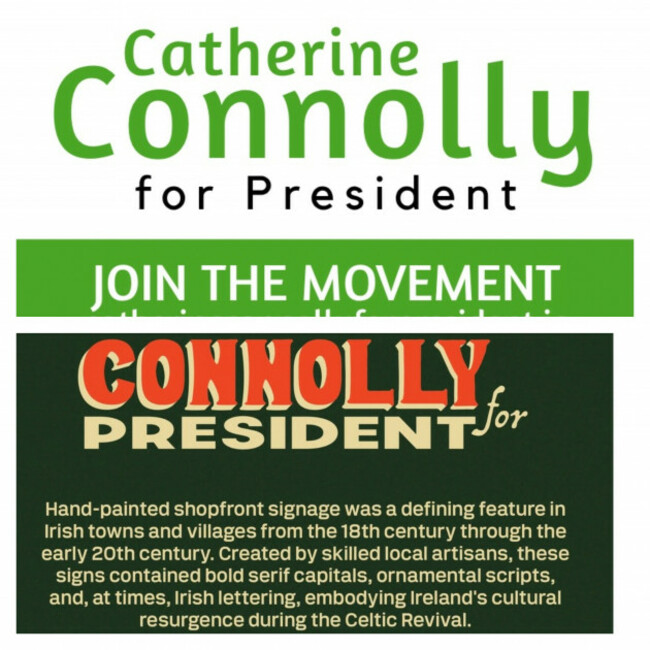
The campaign noted that many of these shop fronts have given way to mass-produced signage from franchised shops, highlighting the essence of Connolly’s campaign: socialism, community-focus, and the promotion of Irish culture and language were hard-baked into how it looked and felt online.
Claire McGowran, campaigns manager with The Wheel – an organisation that boosts the work of Irish charities – headed up a team of 6 volunteers who produced Connolly’s online content.
Since this August announcement, the campaign posted 400 times on Instagram, with many posts achieving likes in the thousands and being widely shared.
The Connolly for President camp also posted over 2,000 tweets and 179 TikToks.
They have also posted constantly on their campaign Instagram account’s stories each day.
This compares with just over 200 posts from Humphreys’s Instagram account, and just over 200 from the Fine Gael account (but most of these were the same content cross-posted). They typically garnered under one thousand likes, and sparked far fewer comments.
The Humphreys campaign also posted over 150 times on TikTok.
Many of these were straightforward photos and simply edited videos; there was an absence of the kind of slick design and messaging that made Connolly’s content look fresh and exciting.
There were light-hearted moments of Humphreys on a motorcycle, and a visit to a coffee shop, but they failed to make a mark.
A lot of the insights into Connolly beyond her political persona have come from her appearances on podcasts, which included The BlindBoy Podcast, Ready to be Real with Síle Seoige, How to Gael, and The Journal’s political podcast The Candidate.
Her appearance on How to Gael, which is a bilingual show that encourages people to bring the Irish language into their day-to-day lives, gave us one of the real viral moments of the campaign when Connolly revealed that she ran a 10km race while five months pregnant in Galway back in 1995. The clip of the show posted on Instagram has been viewed over one million times.
Despite the fact that Connolly’s campaign has been criticised for being slow to reply to questions from some journalists, these appearances made her look open to conversation, more casual than your average politician, and essentially, relatable.
O’Connor, her campaign manager, said that they worked with a number of influencers as well as part of their online strategy. In some cases they reached out to them, sometimes it was the other way around.
“Kneecap’s manager got back to me the other day to say that something [they posted about Connolly] was viewed over 750,000 times, which is just huge,” she said.
Who reached out in that partnership? “It was kind of mutual,” O’Connor said.
She noted that there was a grassroots movement of volunteers that canvassed for Connolly both on the doorsteps and online, but what perhaps made the biggest difference is that the five parties backing Connolly have all been posting relentlessly in support of her.
“We had regular weekly to twice-weekly liaison meetings with political reps from the parties and we exchanged views on what would work, and we encouraged them to create and share content – and then we started to collaborate. It was a very symbiotic, collegiate thing,” O’Connor said.
Will we be seeing more social media content from Connolly when she’s in the Aras as Uachtarán na hÉireann?
“That is a question I cannot answer. We’ll see about that after we get through today,” O’Connor said.

To embed this post, copy the code below on your site














have your say